7 Sesame Grey Granite Buying Tips for Global Buyers
Sesame Grey Granite can look calm in a small sample, then shift noticeably across a full countertop or façade. Its grey field, dark mineral flecks, and occasional lighter patches make batch review important. Buyers should assess more than color. Quarry consistency, slab dimensions, surface finish, edge quality, packing, and delivery terms all affect the final result.
Industry data helps frame those decisions. The USGS Mineral Commodity Summaries 2025 tracks dimension stone as a distinct mineral commodity, while UN Comtrade records international trade in worked stone under HS 6802. These sources are useful for understanding material categories and trade flows, but they do not verify the quality of a particular shipment. Ask suppliers for current quarry details, production photos, inspection records, and clearly identified samples. Then compare those samples with the actual slabs before approving fabrication. Small differences matter.
A polished sample can still mislead. Lighting, resin treatment, and wet surfaces may change how the stone appears. No checklist removes every surprise, and natural variation is part of the material. The following seven buying tips offer global buyers a practical way to evaluate Sesame Grey Granite, ask sharper supplier questions, and reduce avoidable sourcing problems. A little doubt helps. Verify before committing.
Identify Sesame Grey Granite by Mineral Pattern, Quarry Origin, and Commercial Grade
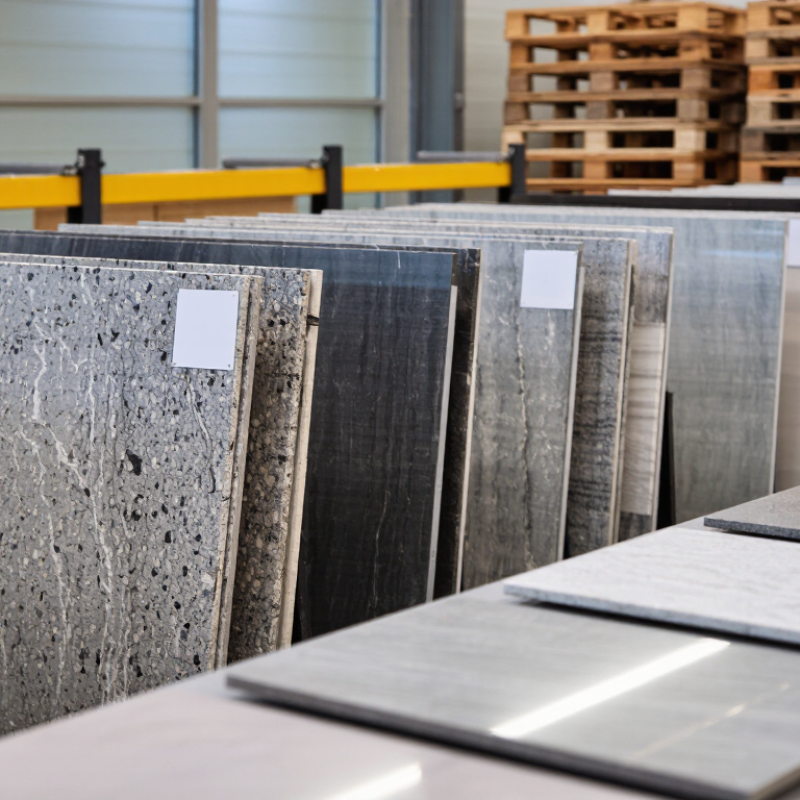
Sesame Grey Granite is recognized by its grey ground color and scattered black, white, and sometimes pale pink mineral grains. The pattern should look consistent across a slab, but not perfectly uniform. Nature leaves variation. View several full-size slabs in daylight, since a small polished sample can hide shifts in grain density and tone. Look closely.
Quarry origin matters because stones sold under similar trade names may come from different regions or benches. Ask the supplier for the quarry location, recent block or slab photographs, and documents linking the shipment to that source. Compare those details with the material you inspect. Samples can mislead. A quarry name alone does not guarantee a matching appearance, especially when extraction moves to a new rock face.
Commercial grade is not a universal classification. Request written criteria for color range, veining, fissures, resin filling, and allowable repairs. Then inspect the actual slabs under side lighting; hairline cracks may appear more clearly that way. Ask for slabs. For large projects, agree on acceptable variation and reserve selected pieces before fabrication. Also confirm thickness and finish, since uneven polishing can change how grey areas reflect light. I would not judge quality from a grade label alone; the inspection standard should be clear to both buyer and fabricator.
Compare Slab Sizes, Thickness, Finish, and ASTM C615/C615M Requirements
7 Sesame Grey Granite Buying Tips for Global Buyers
Compare Slab Sizes, Thickness, Finish, and ASTM C615/C615M Requirements
Sesame Grey granite can vary in tone and grain, even within one shipment. Compare actual slab dimensions with your drawings, not only a supplier’s nominal size. Measure several slabs; edge trimming can reduce the usable area. Check thickness at multiple points, since small variations may affect countertop joints and installation. Common thickness options include 20 mm and 30 mm, but confirm what your project and fabricator require. Ask for the permitted tolerances in writing. Details matter.
Finish changes both appearance and practical use. Polished surfaces bring out contrast, while honed or flamed finishes look more subdued. Review a sample under lighting similar to the installation site, then compare it with production slabs. A small sample can mislead. I would not rely on a catalog image alone.
For ASTM C615/C615M, request test reports for the relevant granite and confirm the edition and project specifications. The standard addresses dimension-stone requirements, but a reference to it alone does not prove every shipment meets your acceptance criteria. Check reported physical properties, test methods, and any specified limits with your project professional. One easy detail to miss is matching the report to the material being supplied. If documentation is unclear, pause and ask for clarification before approving the order.
7 Sesame Grey Granite Buying Tips for Global Buyers
Compare slab sizes, thickness, finish, and ASTM C615/C615M requirements.
Common nominal slab thickness options
The chart shows commonly offered 20 mm and 30 mm nominal thicknesses. Actual availability, dimensions, and thickness tolerances vary by supplier and product.
Before ordering, confirm each slab’s measured size and thickness, request finish samples (such as polished, honed, or flamed), and obtain test documentation stating the applicable ASTM C615/C615M edition and results. The chart shows market options, not ASTM acceptance limits.
Check Test Reports: Water Absorption ≤0.40% and Density ≥2,560 kg/m³
7 Sesame Grey Granite Buying Tips for Global Buyers
A test report can reveal more than a polished sample. For Sesame Grey granite, check whether water absorption is at or below 0.40% and density is at least 2,560 kg/m³. Small details matter. The report should identify the tested stone, sampling date, test method, and units. Check the method. Results are harder to compare when laboratories use different procedures or unclear specimen descriptions.
Ask whether the tested pieces came from the same quarry block or production lot as your order. A passing result from an old sample may not represent the slabs being packed today. Request recent, traceable documentation from a qualified laboratory, and compare the figures with your project specification. If absorption exceeds 0.40%, the stone may take up more moisture than expected; confirm suitability for the intended setting rather than relying on appearance alone. Density below 2,560 kg/m³ also deserves clarification. Neither number tells the whole story. Veining, surface finish, installation details, and exposure can affect performance. I would not treat a neat-looking certificate as proof by itself; verifying the sample link is an easy step to overlook.
Verify Strength: ASTM C615/C615M Sets a 131 MPa Compressive Minimum
For sesame grey granite, color is only the first check; compressive strength deserves a place in the purchase file.
ASTM C615/C615M sets a minimum compressive strength of 19,000 psi, or about 131 MPa, for granite dimension stone. ASTM C170/C170M describes the test method used to measure that property. These figures are useful benchmarks, not proof that every slab in a shipment passes.
Ask for a laboratory report tied to the actual quarry lot or production batch. Check the stone name, sample identification, test date, specimen condition, and reported result.
Dry and water-conditioned results can differ, so confirm which condition the report records. A strong average can also hide variation between blocks. Look closely at visible veins, filled fissures, and edges around cutouts; a number alone cannot show how a particular slab will behave during fabrication. Small detail. I would still pause if a seller provides a report with no traceable sample ID.
For countertop or façade orders, request independent testing when the shipment is large or the application is demanding. Compare the measured value with the ASTM minimum, and ask the lab to clarify any result close to 131 MPa.
Keep the report with the purchase documents, then inspect delivered slabs for matching batch markings. Grey stone varies naturally. That deserves a second check.
Confirm Batch Consistency, Export Packaging, Inspection, and Shipping Terms
Sesame grey granite can vary between blocks, even when the stone comes from one quarry. Ask for current photos or video of the actual production batch, not only polished samples. Compare the background tone, grain size, and mineral specks under neutral lighting. Keep an approved sample for reference. It is useful, but not perfect.
Before production, confirm slab thickness, finish, dimensions, and acceptable variation in writing. Request clear measurements from several pieces, since one attractive slab cannot represent an entire shipment. A third-party inspection can check quantity, surface defects, edge condition, and packing before dispatch. Agree on inspection timing and reporting details in advance. Small chips matter.
Export packaging deserves close attention. Slabs should be secured in suitable crates, separated with protective material, and braced against movement. Ask for crate photos and shipping marks before loading. For container shipments, confirm weight, loading method, and who arranges lashing.
Then define the shipping term precisely, including the named port or destination. Clarify who pays freight, insurance, and local charges, and when risk transfers.
I have seen buyers focus on the stone and overlook unloading costs; that assumption can become expensive. Keep the final specifications, inspection record, packing list, and agreed shipping terms together for quick checks if questions arise.