Home / Blog
Choosing the right pvc doors in 2026 requires more than comparing online prices. Global buyers must examine climate, building use, installation quality, and long-term maintenance. A door that performs well in a dry coastal home may struggle in a humid warehouse. Small details matter, including frame thickness, sealing strips, drainage holes, hinge strength, and glazing options.
This guide focuses on practical buying decisions supported by product specifications, supplier experience, and visible quality checks. We consider thermal insulation, sound reduction, water resistance, security hardware, surface durability, and customization. Certifications can support trust, but they should be verified through recognized testing bodies and current technical documents. Factory photographs are useful. Independent samples are better. A properly packed sample can reveal corner welding, panel alignment, handle movement, and finishing consistency before a large order begins.
No shortlist is perfect. Product data may be incomplete, and supplier claims can sound stronger than real performance. Buyers should request test reports, warranty terms, production timelines, spare-part policies, and installation guidance in writing. Regional conditions also deserve attention. Strong sunlight, freezing temperatures, salt air, and frequent cleaning can change the best choice. Budget matters, but the cheapest pvc doors may create higher replacement and service costs later.
The following overview compares suitable door types for international projects in 2026. It balances appearance with measurable performance. It also leaves room for careful review, because reliable purchasing depends on evidence, not attractive promises.
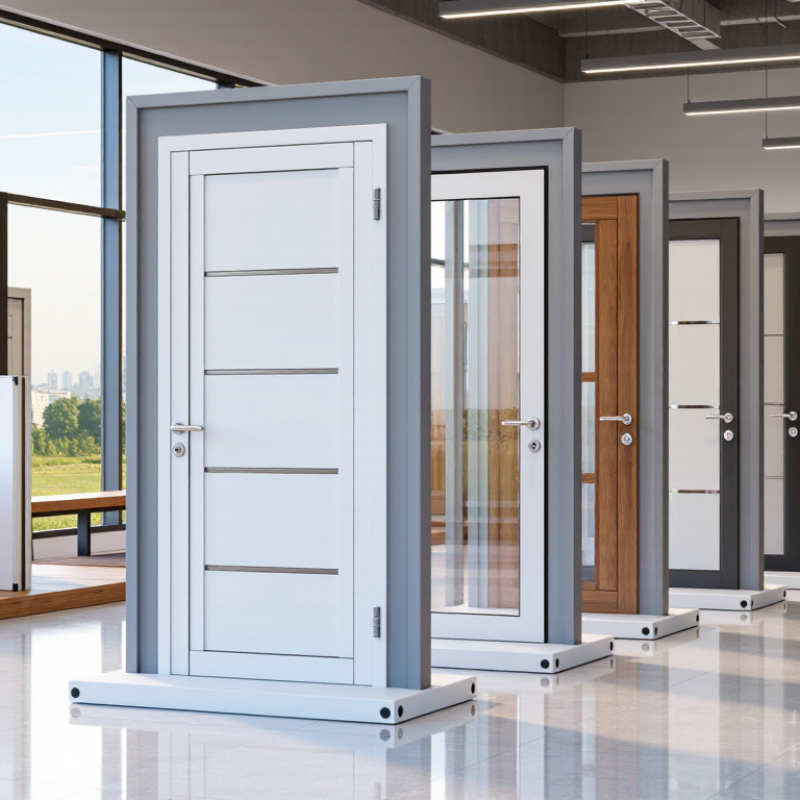
PVC doors are made from polyvinyl chloride profiles, often reinforced with steel or fiberglass. Their hollow chambers improve insulation without creating a heavy door. In 2026, buyers value this balance. A well-sealed PVC door can resist rain, salt air, and daily cleaning. It also avoids routine painting, which suits apartments, coastal homes, and busy commercial buildings.
Energy performance explains much of their popularity. The U.S. Department of Energy reports that windows and doors can influence about 25–30% of residential heating and cooling energy use. PVC frames with double glazing, compression seals, and correctly fitted thresholds can reduce air leakage. Small details matter. A poor installation can cancel a good specification. Buyers should check U-values, air-tightness results, drainage design, and tested hardware rather than trusting the material name alone.
Sustainability needs a more careful view. The VinylPlus 2024 Progress Report recorded 810,775 tonnes of recycled PVC used in Europe during 2023. That progress supports circular manufacturing, but PVC is not automatically sustainable. Recycling access varies by country, and low-quality fittings may shorten service life. Global buyers should request product test reports, recycled-content declarations, warranty terms, and evidence of compliance with local building standards. A door that looks inexpensive may become costly after swelling, seal failure, or replacement glass. That is not a minor concern.
| PVC Door Type | Basic Construction | Typical Applications | Typical Thermal Performance* | Glazing Options | Main Advantages | Key Buying Considerations |
|---|---|---|---|---|---|---|
| External uPVC Panel Door | Multi-chamber uPVC frame with a reinforced leaf and insulated panel sections. | Residential entrances, apartments, low-rise commercial buildings and service entrances. | Approx. whole-door U-value: 1.0–1.8 W/m²K, depending on profile, panel and installation. | Solid panel, decorative panel, double glazing or triple glazing in selected sections. | Low maintenance, corrosion resistance, good weather sealing and broad design flexibility. | Check reinforcement, threshold design, drainage, hardware quality and certified air, water and wind performance. |
| uPVC Glazed Entrance Door | uPVC outer frame with insulated glazing units and a steel-reinforced sash where required. | Main entrances, balconies, garden access and daylight-focused building façades. | Approx. whole-door U-value: 1.1–2.0 W/m²K; performance varies significantly with glass area. | Double or triple insulating glass; laminated or toughened safety glass may be specified. | Natural light, improved insulation compared with single glazing and customizable appearance. | Confirm safety-glazing requirements, spacer type, solar-control needs and condensation resistance. |
| uPVC Sliding Patio Door | Sliding sashes running on tracks within a reinforced uPVC frame. | Patios, balconies, terraces, conservatories and wide indoor–outdoor openings. | Approx. whole-door U-value: 1.3–2.4 W/m²K, mainly influenced by frame and glass design. | Double or triple insulating glass; laminated safety glass for suitable security applications. | Space-saving operation, wide glazed areas and convenient access to exterior spaces. | Inspect track durability, roller load rating, drainage, locking points and resistance to air leakage. |
| PVC Foam-Board Utility Door | Rigid cellular PVC or foam PVC board, commonly used with a light frame and basic hardware. | Bathrooms, storage rooms, utility rooms, workshops and sheltered service areas. | Thermal performance is project-specific; it is generally selected for moisture resistance rather than maximum insulation. | Usually solid; small vision panels may be added where suitable. | Moisture resistant, easy to clean, lightweight and less vulnerable to rot than untreated timber. | Confirm impact strength, screw-holding capacity, dimensional stability and suitability for exterior exposure. |
| PVC Internal Door | PVC-faced or molded PVC leaf with a lightweight internal core and matching frame. | Residential interiors, offices, healthcare areas and high-moisture rooms. | Normally evaluated for acoustic, fire or moisture performance rather than exterior thermal U-value. | Solid leaf, translucent panel or privacy glazing, depending on the room requirement. | Easy cleaning, consistent appearance and good resistance to everyday humidity. | Verify fire rating, acoustic rating, hygiene requirements and compatibility with local door hardware. |
| PVC Folding or Bi-Fold Door | Multiple hinged panels connected by hardware and supported by top or bottom running systems. | Large openings, patios, retail areas, restaurants and flexible room partitions. | Approx. whole-door U-value: 1.4–2.6 W/m²K, depending on panel size, frame and glazing. | Double or triple insulating glass; safety glazing is commonly required for large panels. | Creates a wide clear opening and can combine ventilation with indoor–outdoor access. | Check panel weight limits, hardware cycle testing, threshold accessibility and long-term alignment. |
2026 Best PVC Doors for Global Buyers?
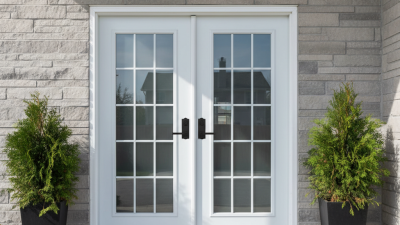
PVC doors now serve homes, apartments, clinics, offices, and coastal buildings. The best choice depends on climate, traffic, security needs, and installation quality.
Hinged PVC doors suit entrances and utility rooms. Sliding doors save space and support balconies or compact apartments. Folding designs create wider openings for patios and cafés. Solid-panel doors work well in bathrooms and service areas. Glazed doors bring daylight, but low-emissivity glass improves thermal control. Multi-chamber profiles, reinforced frames, and compression seals can support insulation and weather resistance.
The UNEP Global Status Report for Buildings and Construction 2024 states that buildings used 32% of global energy in 2023. It also reports that the sector produced 34% of global energy-related emissions. Better door insulation can reduce drafts, although one door cannot solve poor wall insulation. Buyers should compare tested U-values, air leakage, water tightness, and wind resistance. EN 14351-1 and ISO 10077-1 provide useful reference points for external doors and thermal calculations. Local testing remains important.
Tips: Check the frame reinforcement before judging the surface finish. Ask for full-system test data, not only profile claims. Coastal buyers need corrosion-resistant hardware and reliable drainage paths. Measure the opening twice. Installation errors can quietly erase good specifications. A low purchase price may become expensive after swelling, misalignment, or seal replacement. Some designs look modern, but their maintenance access is easy to overlook.
Key PVC door types, designs, thermal performance, and suitable applications
The chart compares common PVC door designs using representative whole-door U-values. Lower values indicate better thermal insulation. Hinged entrance and French doors are generally suitable for residential entrances, while sliding and folding systems are often selected for patios, balconies, terraces, and wide openings. Actual performance depends on glazing, frame design, hardware, installation quality, and local climate requirements.
Data basis: representative industry ranges for insulated PVC door systems, expressed as typical midpoint values in W/m²K; evaluation terminology is consistent with EN ISO 10077-1 principles. Values are for comparison and specification planning, not a product certification.
A reliable PVC door should feel rigid, not hollow or unusually light. Press the panel gently and check for movement around the corners. Strong welding lines should look even, clean, and free from visible gaps. The frame must remain straight after transport and installation. Small defects often become larger problems later.
Examine the internal reinforcement, especially for wide doors or darker colors exposed to strong sunlight. Galvanized steel reinforcement can improve stability, but its thickness and placement matter. Ask for section drawings, material specifications, and test reports rather than accepting general claims. A door may resist water well, yet perform poorly against wind or repeated opening. These are separate tests.
Check the gasket carefully. It should sit continuously around the frame and recover after light pressure. Hardware should operate smoothly without scraping or excessive force. For cold, humid, coastal, or high-heat regions, review weather resistance and corrosion performance. Installation also affects durability. An excellent door can leak when the opening is poorly prepared or the frame is not level. I have seen buyers focus on the lowest quotation and overlook packaging, spare parts, and service response. That choice can become expensive. Not every test report reflects actual site conditions, either. Request samples, inspect the locking points, and compare documented performance with the demands of the intended building.
2026 Best PVC Doors for Global Buyers?
Global PVC door purchasing starts with standards, not appearance. A reliable specification should identify profile strength, glazing type, hardware, and test methods. For European projects, EN 14351-1 may support performance assessment for external pedestrian doorsets, where applicable. PVC profiles are often evaluated against EN 12608-1. Requirements differ by market.
Ask for test reports, factory quality records, and traceable material data. CE marking may apply in relevant European conditions, while other markets may require local conformity documents. North American buyers often review U-factor, air leakage, water resistance, and structural performance through accepted regional methods. A certificate without a matching product model is weak evidence.
Energy efficiency needs measurable targets. Check the whole-door U-value, not only the PVC frame. Low-emissivity glass, insulated cores, warm-edge spacers, and continuous weather seals can reduce heat loss. In hot climates, solar heat gain and shading deserve equal attention. Air leakage matters too. A poorly adjusted seal can waste energy despite good laboratory results.
Measure twice.
Installation changes real performance. Confirm wall depth, threshold height, drainage paths, and exposure to wind-driven rain. Ask whether test conditions match the project climate. Perfect data is rarely available. That is a limitation worth recording, not hiding. Buyers should also verify fire, accessibility, acoustic, and chemical requirements with local authorities before shipment.
Choosing the best PVC doors in 2026 starts with a supplier, not a catalogue. International buyers should verify factory capacity, export experience, and quality controls. Request business registration, production photos, recent test reports, and references from comparable markets. A video audit can reveal storage problems, weak packaging, or limited equipment. Measure twice.
Ask for a complete specification sheet. It should state door thickness, frame material, reinforcement, hardware, glass type, color tolerance, and wind or water performance. Confirm whether test results match the exact model you will receive. Do not accept a generic certificate without checking its issuing laboratory.
Small errors matter. Local building rules and import requirements must also be reviewed with a qualified adviser.
Before placing an order, approve a physical sample or detailed pre-production sample. Record every agreed dimension in the purchase contract. Include acceptable tolerances, carton markings, spare parts, delivery terms, inspection rights, and remedies for defects. A staged payment plan can reduce risk, especially for a new supplier. Use an independent inspection before shipment when the order is large. Check corner welding, seal alignment, surface scratches, and pallet stability. An attractive quotation may hide weak packaging costs. I would question unusually low prices, even when the deadline is tight. Real procurement is less perfect than a spreadsheet suggests. Allow time for revisions, port delays, and one disappointing sample.