How to Choose the Best PVC Double Doors?
Choosing pvc double doors is not just a matter of matching a frame to your home’s color scheme. The right choice should fit the opening, suit how the room is used, and perform well in its local climate. A bright patio entrance may need different glazing and privacy features from a side entrance facing a busy path. Small details matter. Check the frame’s construction, weather seals, hinges, locking hardware, and the manufacturer’s specifications rather than relying on appearance alone.
Start with accurate measurements of the opening, including its width at several points and the available clearance for each door leaf. Decide which way the doors should open, and consider furniture, steps, and outdoor space. For larger glazed areas, ask about glass options, safety ratings, and how the frame is reinforced; exact performance depends on the product and installation. A certified installer can confirm whether the opening needs preparation and explain what the warranty covers. Ask for those details in writing.
There is no perfect door for every home. A lower price may mean fewer finish or hardware choices, while extra features are only useful if they meet a real need. I would not choose by sales claims alone. Compare written specifications, inspect a sample if possible, and check how easy the handles feel to operate. Even then, the decision can be imperfect. That is worth acknowledging. A careful choice balances fit, security, comfort, maintenance, and budget without assuming one feature solves everything.
Choose the Door Layout and Check the Opening Against EN 14351-1
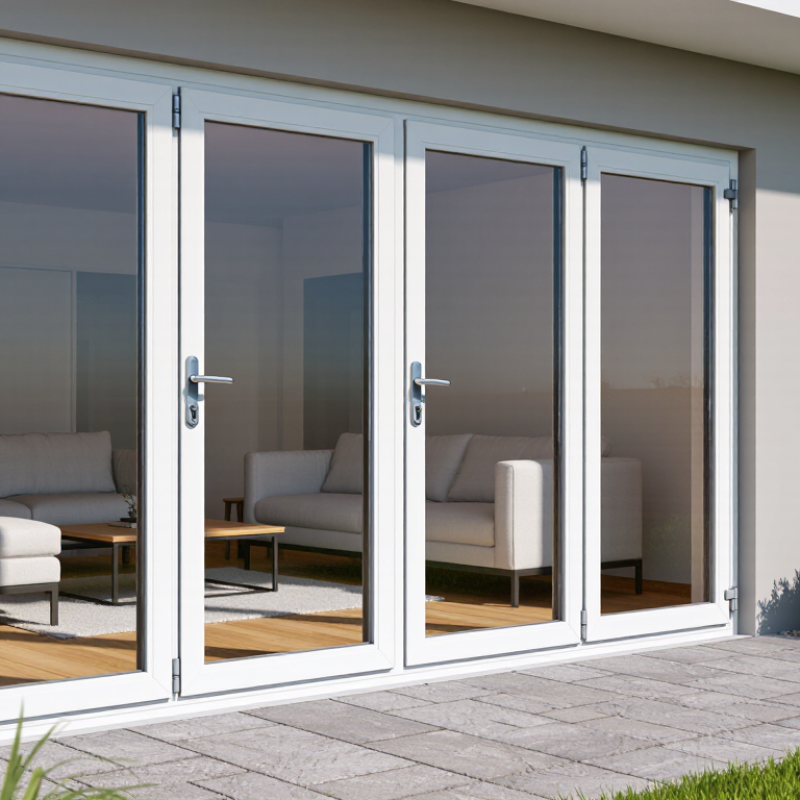
Choose the door layout before measuring the opening. A pair of equal leaves gives a balanced entrance, but each leaf needs swing clearance. An active-and-secondary arrangement can leave one side fixed during daily use. Decide whether the doors should open inward or outward, then check nearby walls, steps, and furniture. I still recheck the diagonals; real openings are rarely perfect.
Measure width and height at three points, and record the smallest readings. Check the diagonals, plumb, and sill level before setting the frame size. EN 14351-1 covers performance characteristics for external pedestrian doorsets, including air permeability. It does not determine your site opening or installation gap. For a useful benchmark, EN 12207:2016 assigns Class 4 air permeability limits of 3 m³/(h·m²) and 0.75 m³/(h·m) at 100 Pa. These are tested product figures, not a promise about a poorly sealed installation. Check the declared performance and allow the fitting clearance specified for the chosen system.
Tips: Sketch the swing arcs on the floor with masking tape. Confirm clear passage width after both leaves and handles are fitted. Keep the measurements, photos, and standard references with the order; one overlooked threshold can change the fit.
Compare PVC-U Profiles: EN 12608-1 Class A Requires 2.8 mm Outer Walls
When choosing PVC double doors, compare the profile specification, not just the frame’s appearance. EN 12608-1 Class A requires a minimum outer wall thickness of 2.8 mm. That matters. Thicker outer walls can provide a more substantial profile, but they do not prove that a complete door will perform well.
Ask the supplier for the profile class and supporting technical documents. Check that the stated 2.8 mm refers to the profile’s outer walls, not a different measurement. A caliper reading on an installed frame may be awkward and may not show every section accurately. Documentation is often the clearer starting point. Still, paperwork alone is not enough.
Inspect the full door system. Look at the reinforcement, corner joints, hinges, locks, seals, and glazing specification. These details affect how the doors feel, close, and resist everyday use. A Class A profile is a useful comparison point, not a guarantee of security, insulation, or durability. Installation also matters: even a strong frame can leak air if the opening is poorly sealed. Specifications can be confusing, and some sales descriptions leave out important measurements. Ask for precise answers before comparing prices.
Check Air Leakage: EN 12207 Class 4 Allows ≤3 m³/(h·m²) at 100 Pa
When comparing PVC double doors, treat air leakage as a measured result, not a sales adjective. EN 12207:2016 classifies air permeability, with Class 4 allowing no more than 3 m³/(h·m²) at 100 Pa. This is a strong benchmark, not zero leakage. The test method is specified in EN 1026:2016. Ask for the full laboratory report, including the tested door size and configuration. A result for a single-leaf sample may not represent a double door with a central meeting stile.
Look closely at the details that control leakage: the seals where the two leaves meet, the threshold, and the corners around the frame. A good score can still disappoint if installation leaves a gap beneath the sill. Small gaps matter. Compare reports at the same pressure and check whether figures are stated per area or per joint length; the units are not interchangeable. I would not choose on the class number alone. It is easy to focus on the neat lab figure and overlook how carefully the door must be fitted and adjusted. After installation, check for draughts around the meeting stile and threshold on a windy day.
Compare Whole-Door U-Values and Verify Insulating Glass to EN 1279
How to Choose the Best PVC Double Doors?
When comparing PVC double doors, ask for the U-value of the complete door, not just the glass. A glass-only figure can look impressive while the frame, meeting stile, or threshold loses more heat. Lower whole-door U-values generally indicate less heat transfer, but compare figures for similar door sizes and configurations.
Numbers need context. Check whether the quoted value includes both door leaves, the frame, and the threshold. A narrow sample or a different opening size may produce a result that does not match your home.
Ask for the insulated glass unit’s specification and evidence of conformity with the EN 1279 series. This standard addresses insulating glass units, including their durability and production controls; it does not certify the thermal performance of the entire door. Look for details such as glass thickness, cavity width, spacer type, and any stated gas fill. Then match those details to the quotation and the test documentation.
A neat number can still hide a weak edge. Installation matters, too: poorly sealed joints can undermine good laboratory figures. I would want the installer to explain how the frame will be fixed and sealed, in plain language.
If one document is missing, pause and ask. That small delay is worth it.
Specify Security Hardware Using EN 1627 Resistance Classes RC1–RC6
For PVC double doors, choose the resistance class for the actual risk, not just the lock specification. EN 1627 rates a complete door set under defined attack tests. RC1 provides basic resistance to physical force; RC2 is tested against simple tools; RC3 includes crowbar-type attacks. RC4 to RC6 cover increasingly capable tools and more demanding tests. Higher classes do not mean a door is impossible to break into.
Double doors need particular attention at the meeting stile. Check that the inactive leaf has secure top and bottom bolts, and that the active leaf’s multipoint lock engages properly. The frame, hinges, glazing, and cylinder must also match the tested configuration. Small gaps matter. A strong lock cannot compensate for weak fixing points or a poorly fitted frame.
Ask for documentation showing the exact door assembly’s EN 1627 class, including any glazed panels and hardware. Do not assume that upgrading one component raises the whole door’s rating. For a typical home with limited exposure, RC2 may be a practical starting point; more exposed locations may justify considering RC3 or above. Installation quality still matters, and it is easy to overlook. Check that the installer follows the tested fixing method, especially where the PVC frame meets masonry.